
Scope of Work in Monterey Hills Vegetation Management Program Does Not Support Goat Grazing
The Project described in the City's CEQA Notice of Exemption does not support the use of goats.
CEQA Notice of Exemption
Document Description
The Project consists of targeted fuel management activities on a total of 35 acres within 100 feet of existing legal residential structures located in High and Very High Fire Hazard Severity Zones on City-owned or City-controlled property. Project activities aim to prevent and mitigate a wildfire emergency through a combination of targeted goat grazing and, where appropriate, limited hand or mechanical vegetation management methods on flammable invasive species, such as dry grasses and brush, which serve as primary fuel for wildfires. By clearing these fuels and creating more open, less dense vegetation, the activities establish natural firebreaks that slow the spread of flames and reduce the intensity of potential fires. This is particularly beneficial in wildland-urban interface areas, as it helps to create defensible space around homes and structures, providing a critical buffer that protects properties and increases the likelihood of successful firefighting efforts during a wildfire event. The site will be monitored and managed by professional staff and the City retains authority to modify or halt activities if site conditions warrant. The grazing activities are planned as a short-term pilot program lasting approximately one month.
The attached document includes maps that do not reflect 100 feet from existing legal residential structures. They instead reflect 100 feet from the borders of the open spaces. There is a clear and obvious internal inconsistency.
Project Scope Extension in Exemption Declarations
The written description should contain the full Project's scope of work.
A stated exemption is not an independent grant of authority to perform every activity that might theoretically qualify for the exemption.
The "Reasons for Exemption" is not the place to define or extend the Project's scope.
Actually Noticed Scope of Work
This is a map showing 100 feet from existing legal residential structures in purple.
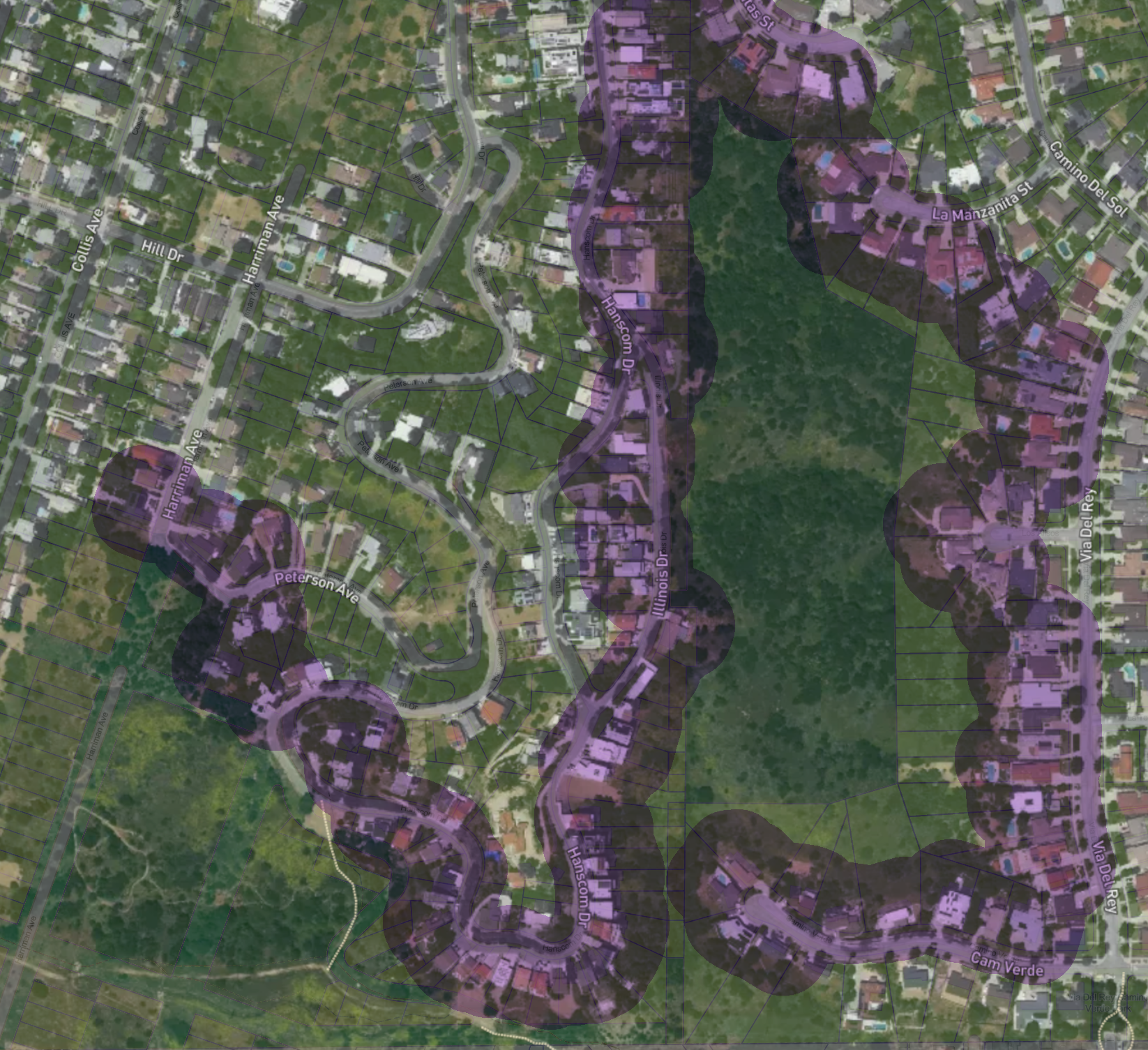
The purple radii covers ~3.75 acres of city-owned open space and paper streets.
The project must be limited to this specific acreage. These areas are not accessible nor desirable areas for grazing.
This is the same map with labels specifying particular nuances of the area.
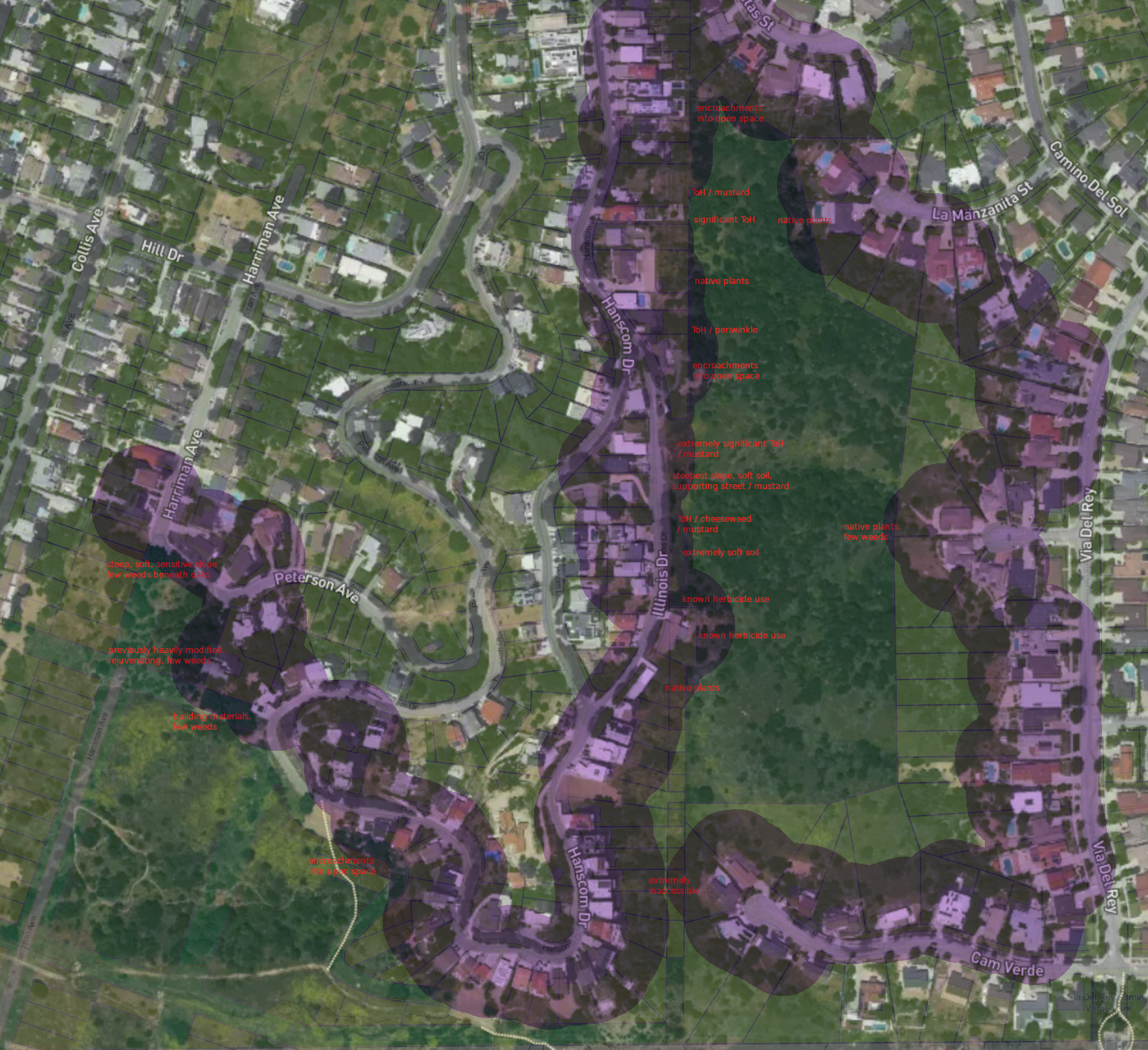
The Tree of Heaven (ToH), periwinkle and poison oak need to be treated with herbicide. The cheeseweed needs to be pulled by the root. The mustard near the edges needs to be treated cautiously to minimize seed bank expansion. Time and energy should not be wasted treating mustard outside of the 100'. The soft soil areas are extremely sensitive and silty soils. The steep slopes have historically been treated fine by men with weed whackers and are extremely sensitive to erosion. The known herbicide use occurs every year and has poisoned me by fingertip exposure alone in a way that other herbicide exposure hasn't implying a strong and dangerous unknown herbicide. No goats should feed on plants anywhere in this area.
Native plants inside of these areas need to be protected, no matter how small, as the first step toward rehabilitating these areas to reduce future workloads and costs and increase long term fire safety. This should include allowing Black Walnut juveniles and resprouting stumps to proliferate. Contractors needs to be able to distinguish between Tree of Heaven (non-native, invasive) and Black Walnut (native, fire-safe) as they look very similar.
This is not a job for goats. This work needs to be done specifically and correctly before scope of work is expanded. There are areas that may be suitable for grazing by professional targeted grazers. They include the large contiguous mustard patches. Grazing of such non-native annuals must be done only on slopes that can support it and should be done during the late spring, after the last rain and before seed set and when the soil is most stable. I still contend that none of the mustard-filled slopes are stable enough for grazing. If there were to be an experiment it would have to be with a small amount of local goats that could be turned away immediately if the soil starts sloughing.
This is why CEQA exists–to make sure that rogue agencies don't carry out unjustifiable environmentally destructive projects, regardless of intentions.
Once again, I volunteer to identify the species ahead of any contractor's work. I volunteer to assist in creating a more comprehensive management plan. I volunteer to perform structural pruning of native shrubs during late winter. I volunteer to plant and foster native fire-safe trees, Oaks and Black Walnut, as a green break all throughout the mustard-filled spaces.
Sincerely,
Angelo Gladding