DEIR Comments for the Arroyo Seco Water Reuse Project
These comments apply to the San Pascual Site.
Invasive Plants
The invasives could be cleaned up by a small group of volunteers in a couple of weekends. The Tree of Heaven could be treated by a certified applicator using a water-safe herbicide applied responsibly. The fig trees are easy to remove. They also provide food for parrots and native animals and birds. The castor stands are minimal. The invasive grasses are minimal. The wetland invasives are performing biofiltration and are species that are easily abatable.
Palm Trees
The majority are not Mexican Fan Palms. They are either fully native California Fan Palms or hybrids of the two. While they are not technically native to this specific area, neither is a year-round river.
native California Fan Palms exist naturally in desert oases with water adjacency similar to this site
they are clearly well adapted to the area
they are not spreading invasively
the ones that have already burned have had their skirts and boots completely burnt and are thus extremely fire-proofed for the foreseeable future
skirtless 60-80' palms are much more likely to naturally shed their new dead fronds from wind
the native Hooded Oriole routinely prefers palms over native trees for nesting
the ones with skirts remaining are high quality bat maternity roosts given their proximity to a water source
the native Western Yellow Bat is locally documented in the broader San Rafael Hills / Los Angeles area and will readily inhabit palm skirts; it is a "species of special concern" and replacement of invasives with native herbaceous plants would increase insect populations enough to attract them to the site to inhabit the palms
Project leads and proponents have constantly beaten the drum of "Most of the removals are Mexican fan palms that are invasive and a fire hazard". The profound naivety of the argument is foully fallacious.
Non-Native Trees
The non-native trees are food for non-native birds, migrating birds and adopted populations such as the various endangered parrot populations that routinely utilize the area. South Pasadena, the City of Trees, has a storied history of planting non-native trees for the purpose of serving these additional bird populations. None of these non-native trees are significantly impacting the native plant or animal populations.
Replacement Trees
Project leads have said that the replacement trees are already being grown. Boxed trees are inferior to smaller trees, particularly poorly timed boxed plantings with a mutilated taproot. The best way to plant an oak is by placing an acorn in the ground. This results in an intact taproot. The next best is a small deep pot. Intact taproots can tap into deeper water reserves and generally make for healthier and faster growing specimens. This is most likely how the current trees have come to exist on site.
Kept Trees
The majority of the pool-adjacent trees that will be kept are too close to the upper boundary of the water level during wet weather flows. Sustained wet weather will starve the trees of oxygen. The current trees' 100 year old root systems are adapted to the current hydrology. The grading activities will destroy their root systems. The resulting pools will give them too much water where they aren't used to it. All of the kept trees will be extremely damaged and stressed, quite possibly making them extreme hazards due to their significance.
Trash
A small group of volunteers removed the sweeping majority of trash across the entire site in a couple of hours. The argument that the forest needs to be flattened because it is trash filled is foully fallacious.
Light Pollution
The parks have extremely bright lights until 9-10pm. Nighttime lights, especially powerful sports field lights, impact humans, insects and animals. The maturity of the current forest blocks the light from the interior of the park and from the neighborhood on the opposite side. The palms play a role, the kept trees that would almost certainly face decline play a role. The sheer volume of biomass blocks a significant amount of light pollution that would not ever be recreated by the new plans.
Noise Pollution
The density of the forest blocks noise. The sports fields are loud. The forest blocks it completely. The replacement would not perform this right away nor would it after it is densely planted.
Unhoused Occupants
The second a new space has fully leafed out, members of the local Arroyo Seco unhoused population will use it once again. The plans do not appear to alter the bridge in any kind of a fashion that will deter the current or future unhoused individuals from taking up residence. Using the unhoused population as evidence of the site needing to be demolished is foully fallacious.
Concretization
The basin of the pits will be lined with concrete. It will be visible as there appear to be no floating plants in the landscape plan. Just a plain concreted bottom. The water level will drain down daily to be entirely limited to the concreted area. Any wildlife that requires there be constant water and plants cannot exist.
Surrounding the site with concrete drastically reduces its functional acreage. It puts the pathways on the edge completely detracting from any sense of surrounding. There'll be a concrete channel with water, concrete walls of the channel, a concrete path, a pool with plantings. From a massive forest with significant understory to an expanded concreted channel.
The concrete strip down the center of the site just adds to the misery. It's there for facilities access not for human enjoyment or ADA access. This plan is water treatment facility first, nature on top. This is not a nature-based water treatment system.
Water Wildlife
What affect will the water levels dropping to the concreted basin have on fish and other water wildlife? The plans simply revoke the idea of it being a habitat waystation for returning steelhead trout as a part of later full-channel restoration system.
Loss of Wildlife Habitat
Removal of the existing biomass is a Massive Environmental Impact. Massive. With losses in Altadena and the adjacent mountains from the Eaton fire, Pasadena's recent shrub loss from the catastrophic goat grazing failure, South Pasadena's pending Monterey Hills open space habitat destruction, this is just a massive loss of native biomass.
Biofiltration
The current system has weep holes all along the channel side of the site. This means that water is flowing from the river, down through the soil, back into the channel. If the soil is active and full of roots, significant biofiltration is currently happening by non-wetland plants. This has not been measured at all. The lead project engineer pointed to the weepholes as a critical part of the infiltration-based biofiltration of the new system. Then it's a critical part of the existing system's existing biofiltration mechanics.
Analyze the sulfuric marsh-like muck. People see it and think yuck. Perform an in depth analysis of the existing biofiltration mechanism of the boggy marsh at the damn. I believe it is performing extensive biofiltration and also polluted by heavy metals and the sort. How will the new system not devolve into a similar state over time? Why can't this muck be maintained as is?
Infiltration
The bedrock on site makes aquifer recharge on site unlikely. The infiltration to groundwater will seep laterally. This sends the water into the main concreted channel or into the sports fields. The amount of water currently flowing through the system is a mere fraction of the proposed pool sizes. What affect will this have on the adjacent channel, the adjacent road and the adjacent sports fields?
Pool Sizes
The wet weather pools are vast. They are deep enough for an adult to not be able to touch the ground. There is a real drowning potential that does not exist at the current site. South Pasadena staff already holler "liability" with respect to river access and drowning potential. How will the pools and site be both accessible for pleasure and safe from drowning potential?
Wind blowing across pools during wet weather will be cold and unpleasant.
What likelihood is there for mosquito habitat? The current river has water wildlife that can access the entire stretch. They'll eat the mosquito larvae. What will control mosquitos in the new plan?
Landscape Plantings
The only Toyons on the site are stuffed around the pump station with nowhere near enough room for their mature size.
No Laurel Sumac, no Sugar Bush, no Coffeeberry, no Hollyleaf Cherry, no Hollyleaf Redberry. These are the native shrubs with the most significant volume, aesthetic and habitat value. This is most likely due to lack of space due primarily to encirclement of concrete. The paltry insignificance of the new design cannot be understated. The loss of old growth shrubs is just as important as the loss of old growth trees. The massive Laurel Sumac covered in Poison Oak cannot be replicated. The path meandering around it is a wonderful delight that the new plan simply does not even make an attempt at. The new plans do not come anywhere close to reconstituting the habitat volume the existing site possesses.
Wetland Plantings
The same quantity of wetland plants in the plans could be planted on the current site. THE SAME QUANTITY OF WETLAND PLANTS IN THE PLANS COULD BE PLANTED ON THE CURRENT SITE.
The current site is loaded with cattails. Cattails, while non-native and invasive, are not invading the channel and are well known to be the gold standard in not only biofiltration but phytoremediation as well. They biofilter more extensively than other wetland plantings. The maintenance is trivial. You cut them back and send the cuttings to the dump. The invasive nature means you can reliably remove entire sections for total pollution removal of the entirety of the plant material and the spaces will fill right back in.
WHAT EFFECT DOES THE CURRENT SYSTEM HAVE ON BIOFILTRATION!? The current site is more than likely already extensively filtering biological contamination in dry weather flows, the ENTIRE stated impetus of the project.
Soil Quality
The wet weather system is designed to embed the first flush. The first flush is full of the entirety of Pasadena's filth. The entirety of Pasadena's filth will be stored in the upper banks of the pits. Then when the wet weather system is turned off the water level lowers and the filth resides in the open air. The accumulation of filth in the upper banks, closest to pedestrians, will be unmanageable due to plantings existing in the space. Winds will blow the filth into the sports fields and into children's lungs.
Water Quality
There are absolutely zero water tests from the site. Despicable. DESPICABLE. DOWNRIGHT DESPICABLE.
Tests at intake, tests throughout the river, tests at the marshy damn, tests in the tile tunnel, tests at the mouth and throughout the golf course wetland, tests at the golf course reservoir, and tests at the outfall. Test for everything: e. coli, heavy metals, herbicides, pesticides, etc.
How DARE you be seven years into a water treatment project of this scale and magnitude and have ZERO on site water tests. HOW DARE YOU!? Models? Because of "Models"? Shame on everyone involved.
Maintenance
There is absolutely no maintenance plan. The project lead and the lead engineer both confidently asserted that they would "figure it out as we go" when I met with them in person just a couple months before this DEIR deadline.
The current site is unmaintained. The current site needs maintenance. If the current site was maintained it wouldn't be fodder for total destruction. How can the site be maintained as is? Why can't the site be maintained as is?
Complexity of System
The system is extremely complex. Maintenance increases exponentially with the number of subsystems, filters, and not only pumps but sensor-driven pumps. A sensor at the reservoir a quarter mile away needs to communicate with the pumps on site to dump and refill the pool every morning. Apparently there's going to be a centralized dashboard to control everything?
The system is VASTLY too complex on it's face. What are the failure modes? Have they been enumerated? The lead engineer mentioned a failed pump or filter filling the pools and overflowing at a high-point drain. Does that mean a failed system will keep the water level at the highest point in perpetuity outside of wet weather events? That will be a death sentence to kept trees or any landscape plantings expecting short term flooding.
Who will fund the technology in perpetuity? Are there allocations for technological maintenance in perpetuity? The filters need to be maintained/cleaned but also replaced entirely when they fail. Same with the pumps. Same with the sensors. Same with the dashboard. Same with the electrical lines connecting everything.
Water Board-hosted stormwater guidance cautions that large-scale or basin-wide methods "may be too complex, costly and/or inefficient to be useful for smaller sites" and may overlook "important micro-scale details and alternatives." The DEIR should therefore explain why a complex, centralized treatment facility is appropriate within this confined and ecologically sensitive Arroyo site, rather than a simpler localized approach that conserves existing natural systems. See www.waterboards.ca.gov/rwqcb2/water_issues/programs/stormwater/muni/nrdc/16%20residential%20storm%20water%20management.pdf
Fault Lines
There are notable fault lines in the area and susceptibility to earthquake damage is likely. How will this affect the significant technology at the site? How will an earthquake combined with a full pool affect the already damaged adjacent primary channel?
Cultural Resources
Historical imagery overlaid against current day shows historic San Pascual site remained while channelization was installed West of it. Sections of the historic Arroyo Seco North and South of the site were channelized. This remains the only intact section of the historic Arroyo Seco in this area.
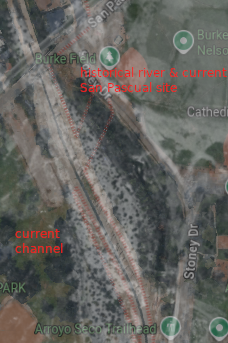
Water is life. Indigenous people of this region's past heavily utilized the abundance river adjacency afforded. Representatives of the Gabrielino-Kizh have confirmed this. This being the only intact stretch of river in the area gives it a clear cultural significance. This site would have been the last area of pre-civilization left for indigenous to walk the same land as their ancestors during the final years of the invasion by foreigners–rough language but true. This has been confirmed by representatives of the Gabrielino-Kizh. There are other sensitive events that have happened at this site due to this as well. The sensitive nature of these events should not be spread widely, should not be forgotten, should not be ignored.
Project proponents referring to the site as an "unused dyke" or "clearly previously disturbed" or "already manufactured" to justify its lack of cultural significance is foully fallacious.
Flight C_1394, Frame Z-78, February 25, 1931 mil.library.ucsb.edu/ap_images/c-1394/c-1394_z-78.tifOutreach
There have been ZERO open public outreach meetings of any significance. A project of this scale and controversy should have a non-stop carousel of outreach meetings that include city officials and question and answer sessions.
I demand to know why taxpayer dollars went to this privately held "stakeholder" meeting at the beautiful La Casita del Arroyo while project opponents have been gaslit and ridiculed. CROOKED AND CORRUPT – no other way to interpret it.
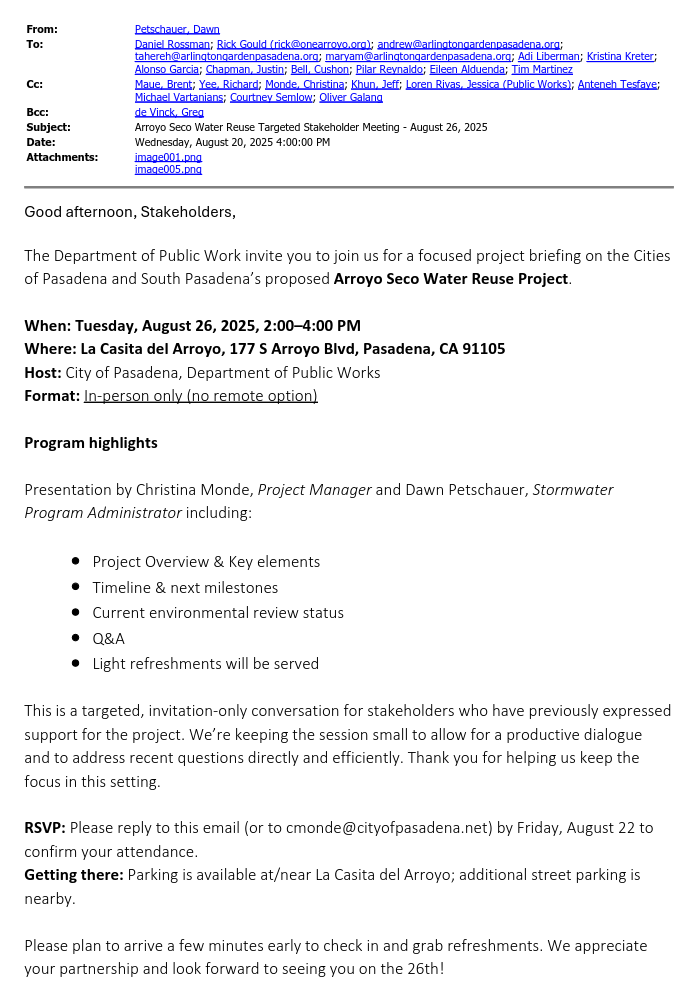
To corroborate the $790.81 see "Reservation Fees" at www.cityofpasadena.net/parks-and-rec/parks/la-casita-del-arroyo
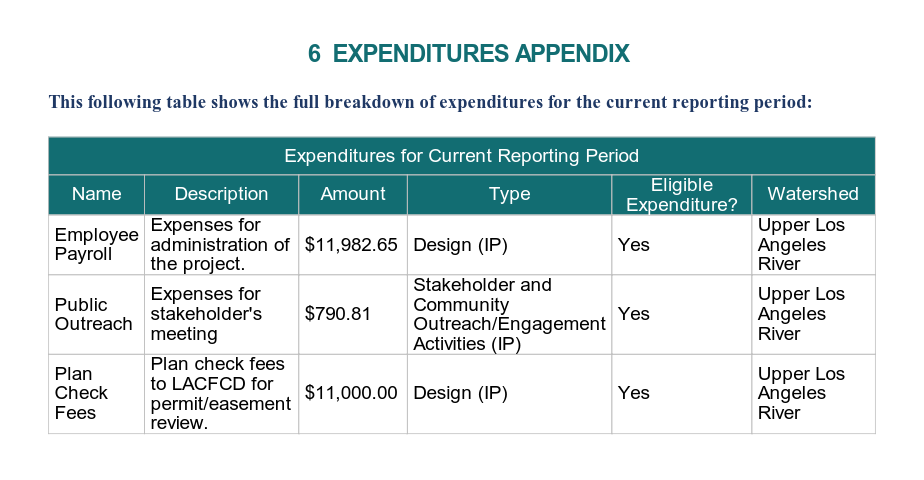
Proponents went to an elderly West Pasadena Resident's Association (WPRA) chair's home and completely misrepresented the project and defamed key project opponents by name. I just so happened to knock on the person's door one day after they were approached by three unknown women somehow affiliated with the lead agency and project. The person was clearly manipulated and was distraught when I explained the other side. Dirty outreach tactics by the lead agency and the non-profit One Arroyo Foundation. I demand a FULL accounting of all such outreach campaigns and all actions with local non-profit associations including One Arroyo Foundation, ActiveSGV and the like.
Alternative Design
Spend the money on an alternative design that rehabs the site minimally. Keep the good, clean it up, add technology minimally and in such a fashion that it doesn't impede natural systems, and leave the historical sensitivity of the site intact.
Angelo Gladding, South Pasadena Resident